
Director of Education – Hannah Tejeda
How school environments can stop penalizing deep focus —
and start building infrastructure for it.
It’s an Emergency
Walk into any traditionally designed school hallway between class periods. The fluorescent lights hum. Lockers slam. People pour in from every direction. Announcements crackle over the PA. For many individuals — roughly 15–20% of the school-age population who are neurodivergent — this scene isn’t just noisy. It’s a neurological emergency.
For learners with ADHD, autism, or what researchers increasingly describe as a monotropic cognitive style, transitions between spaces are among the most destabilizing moments of the school day. And yet school design has largely ignored them.
We build classrooms. We forget the spaces in between.
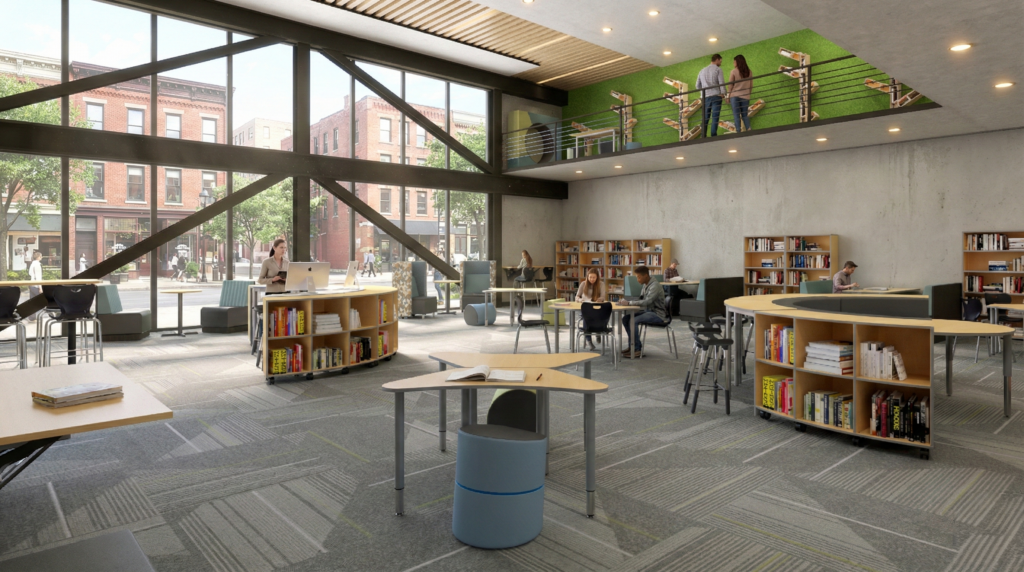
We’re making the case for disruptive design… getting uncomfortable and creating spaces that understand monotropism — an attention-based framework with strong research roots. This mindshift should fundamentally reshape how we design buildings, hallways, and transitional spaces.
Because the physical environment isn’t neutral. It’s either working for the learning community, or it’s working against them.
Primer: What Is Monotropism?
Monotropism is a theory of attention developed by autistic researchers Dinah Murray, Wenn Lawson, and Mike Lesser in the late 1990s and formally published in 2005.
Rather than framing autism as a disorder of deficits, the theory describes autism — and increasingly ADHD — as a difference in how attention is allocated.
Essential Concept: monotropic minds tend to concentrate available attention resources into a narrower, deeper channel at any given time, rather than distributing attention across many simultaneous inputs. When that attention tunnel is engaged, competing stimuli — sounds, movement, unexpected sensory events — don’t just distract. They rupture the tunnel entirely.
This is known as a monotropic split — a forced SPLIT of attention that triggers dysregulation, anxiety, and in some cases, shutdown or meltdown.
For All Learning Profiles
Surfacing research is now showcasing that monotropism extends meaningfully beyond autism. A 2024 trans-diagnostic study by Dwyer, Williams, Lawson, and Rivera found elevated hyperfocus in autistic, ADHD, and combined autistic/ADHD groups alike — and found that hyperfocus and inattention, strangely enough, were positively correlated. That is: the same underlying atypical regulation of attention produces both the deep-dive focus and the fragmented distraction, depending on context.
“Hyper-focus and inattention might at least in part be different manifestations of an underlying atypical regulation of attention involved in both autism and ADHD.” — Dwyer, Williams, Lawson & Rivera, Neurodiversity, 2024
What does this mean?
The environment either supports the attention tunnel, or it destroys it. And once it’s destroyed, re-entry is costly — cognitively, emotionally, and behaviorally.
Why This Is a Design Problem
Traditional environments are built around polytropic assumptions — the idea that individuals can distribute attention across multiple simultaneous channels, shift fluidly between tasks, and regulate their responses to unpredictable sensory environments.
As researcher Fergus Murray of Monotropism.org has noted, education systems are built to honor polytropism — the neurotypical default of spreading attention broadly. They reward switching, multitasking, and sustained performance across diverse and changing environments.
For monotropic learners, this cultural bias creates constant pressure to function in ways that are fundamentally misaligned with their cognitive foundation.
The built environment is a direct expression of that bias. Open-plan classrooms. Hallways designed purely for transit. No acoustic separation between zones. Unpredictable spatial layouts. Stimulation-heavy bulletin boards at threshold spaces. These are not neutral design choices. They are structural disadvantages for monotropic minds.
MOST IMPORTANTLY: they undermine the very behavioral frameworks — MTSS, PBIS — that schools invest heavily in implementing. The research literature on Multi-Tiered Systems of Support is clear that proactive environmental conditions are foundational to behavioral regulation at Tier 1. But most MTSS implementation guides focus on adult behavior and instructional practices. The physical environment is treated as a fixed backdrop, not a variable.
It shouldn’t be. The building is a Tier 1 intervention.
Why This Is a Design Problem
Traditional environments are built around polytropic assumptions — the idea that individuals can distribute attention across multiple simultaneous channels, shift fluidly between tasks, and regulate their responses to unpredictable sensory environments.
As researcher Fergus Murray of Monotropism.org has noted, education systems are built to honor polytropism — the ne
Design Principles for Monotropic Learners
- Reduce Involuntary Attention Demands
Sensory design is not a comfort measure; it’s a cognitive accessibility measure.
Key strategies include:
- Acoustic buffering through sound-absorbing materials (carpet, ceiling baffles, soft wall panels)
- Diffused and adjustable natural lighting that eliminates the flicker and hum of fluorescent fixtures, and visual calm in learning environments
- Minimal wall clutter, muted color palettes in work zones, and organized rather than decorative display systems.
A 2025 architectural study found that sensorially controlled environments — particularly those carefully managing lighting, color, visual cues, and acoustics — meaningfully reduce stress, improve emotional regulation, and enhance attention for learners with ASD and ADHD.
- Design for Transition, Not Just Destination
Hallways, classroom thresholds, and common gathering spaces are where regulatory systems are most taxed and where behavioral incidents are most likely to occur.
Design responses include:
- Gradual sensory transitions between loud and quiet zones (rather than abrupt acoustic shifts)
- Visual floor or wall cues that signal a change in spatial context
- Decompression alcoves positioned just inside or just outside doorways — small, low-stimulation spaces for arriving and regulating before entering the primary learning environment.
Research on sensory design for transition spaces confirms that carefully planned acoustic control, calming lighting, and visual navigation tools — alongside designated self-regulation zones — can reduce stress and behavioral incidents while supporting independent navigation for neurodiverse individuals.
- Zone for Depth
For monotropic learners, the relevant variable isn’t volume — it’s the degree to which a space supports sustained, single-task, deep-focus work.
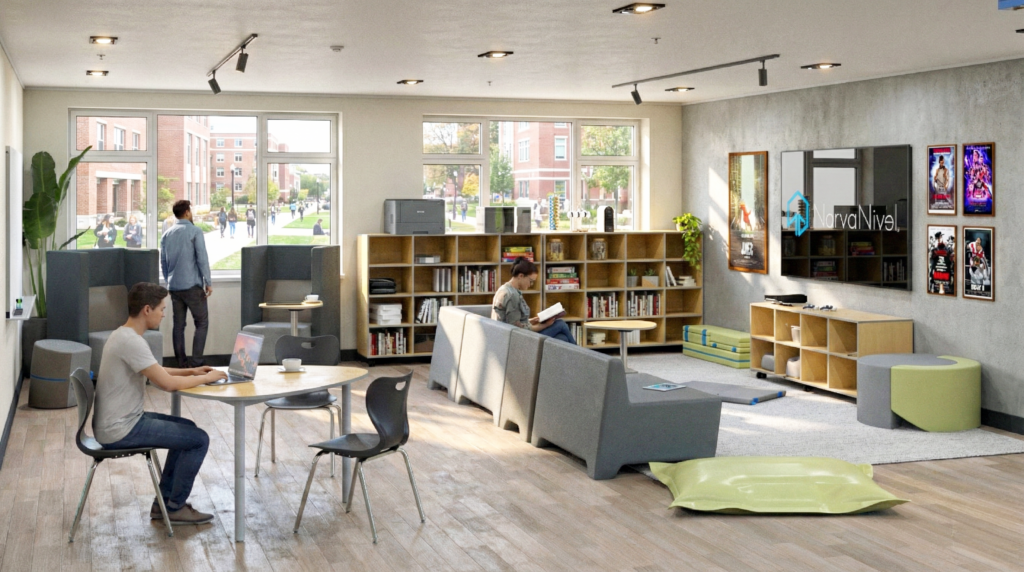
- Focus pods (semi-enclosed individual or pair workspaces with high visual privacy and minimal sightlines to movement)
- Interest-anchored areas associated with specific tools or modalities
- Predictable spatial organization all signal that depth of engagement is architecturally valued. These are not isolation chambers — they are the spatial equivalent of an uninterrupted hour.
- Build in Environmental Control
The ability to modulate one’s own sensory environment dramatically reduces the cognitive load that competes with focus.
Individual control over lighting (task lamps, adjustable blinds), personalizable workstations, and the ability to predict spatial layouts across time are all design features — not luxuries.
A 2024 research toolkit developed for inclusive learning environments for ADHD learners identified sensory regulation, predictability, flexibility, and comfort as the four core design principles most supported by evidence. All four depend on user agency — the capacity of the individual to shape their environment to match their current attentional state.
- Safety Through Stability
Trauma-informed design and neuroaffirming design converge on a shared finding: environments that feel predictable and warm reduce hypervigilance and free attentional resources for learning. For monotropic learners, anxiety about the environment is not separate from the capacity to focus — it is in direct competition with it.
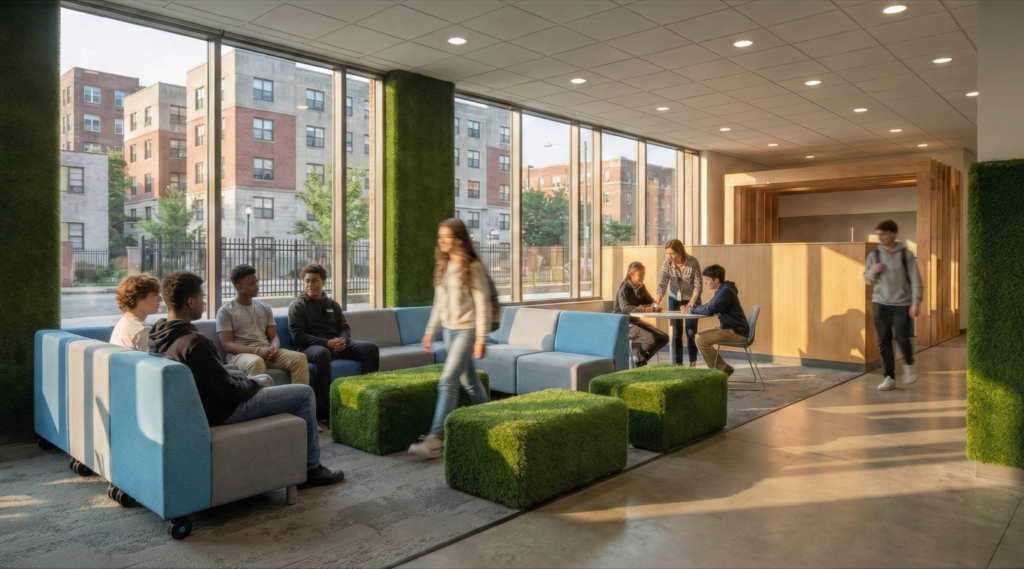
- Warm, home-like materials (wood, fabric, plants)
- Human-scale furniture
- Defined enclosures rather than large open exposures
- Stable spatial arrangements all contribute to a baseline sense of safety.
The BSI’s 2022 standard PAS 6463: Design for the Mind — the first international building standard to address neurological difference — specifically identifies sensory design considerations including lighting, acoustics, flooring, and décor as fundamental to inclusive built environments.
- Hallways are Regulation Infrastructure
“Hallways are not passageways. For monotropic learners, they are the connective tissue of the school’s behavioral ecosystem.”
The heart of it all: The hallway is the most underdesigned space in most school buildings. For neurotypical students, it’s a passageway. For monotropic students, it’s often the most challenging environment they face all day.
Reimagined, hallways can serve as re-entry ramps after dysregulation:
- Sensory calibration zones with embedded movement opportunities (balance features, textured walls, vertical fidget panels)
- Cultural signals that depth of focus is honored, not pathologized — through individual expertise displays and interest-anchored visual environments.
Critically, hallway design is a Tier 1 PBIS intervention. A hallway that is behaviorally predictable, sensorially manageable, and structurally supportive of re-regulation reduces the probability of behavioral incidents before any adult has to intervene.
urotypical default of spreading attention broadly. They reward switching, multitasking, and sustained performance across diverse and changing environments.
For monotropic learners, this cultural bias creates constant pressure to function in ways that are fundamentally misaligned with their cognitive foundation.
The built environment is a direct expression of that bias. Open-plan classrooms. Hallways designed purely for transit. No acoustic separation between zones. Unpredictable spatial layouts. Stimulation-heavy bulletin boards at threshold spaces. These are not neutral design choices. They are structural disadvantages for monotropic minds.
MOST IMPORTANTLY: they undermine the very behavioral frameworks — MTSS, PBIS — that schools invest heavily in implementing. The research literature on Multi-Tiered Systems of Support is clear that proactive environmental conditions are foundational to behavioral regulation at Tier 1. But most MTSS implementation guides focus on adult behavior and instructional practices. The physical environment is treated as a fixed backdrop, not a variable.
It shouldn’t be. The building is a Tier 1 intervention.
What to Avoid
|
Design features that work against monotropic learners: |
|
• Open-plan classrooms without acoustic and visual subdivision — among the most hostile environments for monotropic attention |
|
• Unpredictable spatial arrangements (frequently rearranged furniture without student input or warning) |
|
• High-stimulation threshold spaces — busy bulletin boards, loud common areas, or sensory chaos immediately at classroom doors |
|
• Fluorescent lighting with flicker, hum, or harsh color temperature — a well-documented sensory stressor for autism and ADHD |
|
• Symmetrical, minimalist corridors with no wayfinding differentiation — disorienting for students with attention and spatial differences |
|
• One-size flexible furniture requiring constant reconfiguration — which becomes its own attentional and regulatory cost |
Say Hello to a New Built Environment
Design implementation should ask the question, “how can we help attention flow” rather than “how do we fix this individual”. Monotropic v polytropic is not a “problem to be fixed” – it’s a difference in information flow and focus rate.
Effectively designed learning spaces answer these questions before any individual enters the environment.
Sources
Dwyer, P., Williams, Z.J., Lawson, W.B., & Rivera, S.M. (2024). A trans-diagnostic investigation of attention, hyper-focus, and monotropism in autism, attention dysregulation hyperactivity development, and the general population. Neurodiversity, 2. https://doi.org/10.1177/27546330241237883
Murray, D., Lesser, M., & Lawson, W. (2005). Attention, monotropism and the diagnostic criteria for autism. Autism, 9(2), 136–156.
Garau, V., Murray, F., et al. (2023). Development and Validation of a Novel Self-Report Measure of Monotropism in Autistic and Non-Autistic People: The Monotropism Questionnaire. [Pre-print]
Heasman, B., et al. (2024). Autistic flow theory: A qualitative study presenting a non-pathologising approach to autistic well-being. [Referenced in Reframing Autism, 2025]
BSI. (2022). PAS 6463: Design for the mind — Neurodiversity and the built environment. British Standards Institution.
National Autistic Society UK. (2024). What is monotropism? Understanding a neuroaffirming theory of autism. autism.org.uk
Cannon Design. (2024). Designing for Neurodiversity: An autistic teenager in school. cannondesign.com
MDPI. (2025). Sensory and Interactive Architectural Design Strategies for Inclusive Early Childhood Learning Environments Supporting Neurodevelopmental Diversity. Buildings, 6(1), 44.
Openaccess CMS. (2024). Inclusive Design Strategies for Neurodiverse University Learning Environments: Developing a Practical Toolkit. Applied Human Factors and Ergonomics International.
Monotropism.org. Murray, F. ADHD and Monotropism. monotropism.org/adhd
Center on PBIS. (2021). Multi-Tiered System of Supports (MTSS) in the Classroom. University of Oregon. pbis.org
Bronfenbrenner, U. (1979). The Ecology of Human Development. Harvard University Press.