Hocus Pocus! Everyone Focus!”
“1 – 2 – 3, eyes on me!”
“Criss Cross Applesauce”
“Feet on the floor, cheeks in the seat”
The list of ‘attention getting’ calls and responses continues for miles and miles.
Although these rhythms and rhymes can be used as helpful tools, there’s an underlying expectation that should be highlighted –
By the time we are done with the call and response, bodies should be calm, voices should be off.
Where do these expectations come from? These subconscious socially-agreed-upon sets of expectations that listening looks like a calm body and voices off. And how are they defined? What does it mean to have a calm body? What does it mean to have voices off?
Fight, Flight, Freeze
There is familiarity surrounding responses such as fight or flight. However, there is a common third response, especially within the developing bodies and minds of school aged children: FREEZE.
Freeze refers to the inability to maneuver out of fight or flight states. It’s a reaction which manifests in disconnection, disassociation, dysregulation of time, muted sensory perception, and even physical numbness.
This slow motion survival response can be difficult to observe and analyze. It can also be difficult to ‘snap out of’ as an individual who is experiencing system shut down. One of the biggest hurdles for educators and learners regarding the functional freeze state, is that those experiencing these responses might remain partially coherent and verbally responsive. They may also be unaware of their transition into the freeze state, which makes it difficult to communicate immediate needs.
Stillness: A Misconception
Often, young children do not have the physiological capacity to ‘protect’ themselves – many times the sense of a threatening scenario can trigger fight, flight, or freeze. According to Psychology Today, these threatening scenarios can even look like facial expressions communicating:
- Rejection
- Scorn
- Disapproval
Scenarios can also look like:
- Phobias
- Panic Attacks
- Obsessive Compulsive Disorders
The transition to a functional freeze state is always unconscious. It is a subconscious effort of the mind and body to protect itself.
Because so much of this state is misunderstood or unknown – simple cues within educational settings can cause freeze triggers. Misconceptions such as undivided attention and non-verbal active listening can add to the misconception of stillness equating to respect or ‘active listening’.
The Journal of Orthopedic & Sports Therapy released an article titled “Sit Up Straight: Time to Re-Evaluate” in 2019. The article emphasizes that recommending ‘sitting up straight’ with zero sufficient evidence of efficiency or appropriateness is not conducive to development. Not only is it not conducive to development – it’s actually the opposite of what our bodies need.
According to a plethora of scientific articles and journals, humans are physically incapable of “sitting straight” and “sitting still”.
Noncomprehensive list showing why sitting still is challenging:
- Physiological Adaptation
- Muscular Fatigue
- Circulation and Metabolic Changes
- Neurological and Sensory Needs
- Postural Sway
NeuroSpark discusses freeze state aftermath within neurodivergent individuals when forced to ‘sit still’.
Neurodivergent populations can easily enter a functional freeze state due to –
- Sensory Overload/Underload
- Social Overwhelm & Masking
- Executive Function Challenges
- Emotional Overload
Support for Functional Freeze ranges from tone of voice and body positioning to helpful sounds and regulatory body movement. These support strategies assist stepping out of or coming down from the Functional Freeze State. But, what if we could preemptively support individuals before fully moving into freeze?
Let’s not get ahead of ourselves – for many individuals, the freeze state is inevitable. However, there are support systems that can be introduced prior to any state shift.
Enter Needs-Based Design
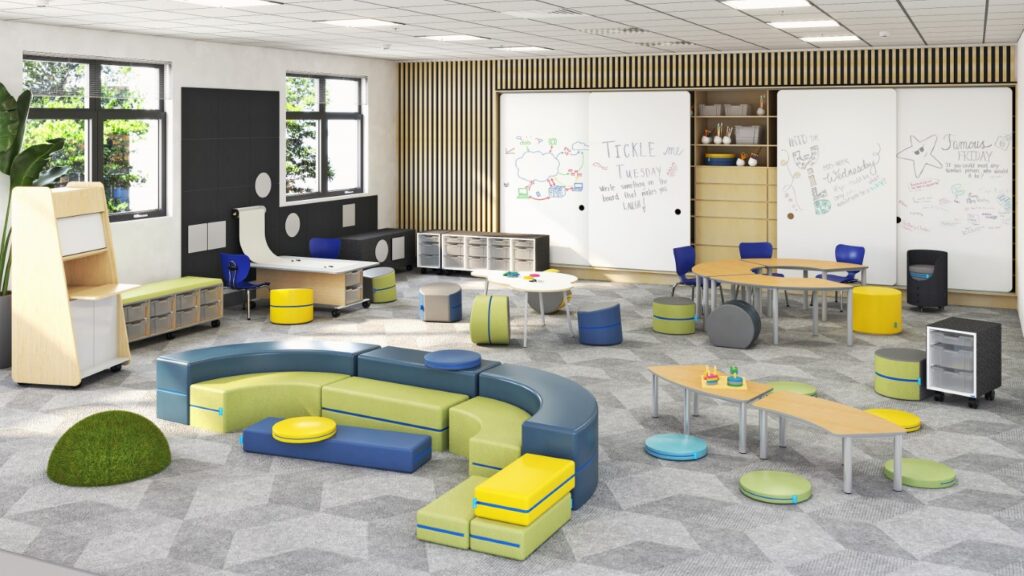
Needs-based design is just that – designing holistic spaces for the many, keeping in mind the needs of the one. Needs-based design considers how physical space can support or prohibit physical, mental, and emotional growth.
Key Elements of Needs-Based Design
- Social Connection – Subconscious flow of space, room for independence and togetherness, fluidity between knowledge origin and discussion
- Pretend Play – Loose buildable parts, items to come together and break a part
- Flexible Thinking – Multiple configurations and styles, personalized options and curated layouts
- Building Confidence – Physicality representing trial and error processes
- Restorative Opportunities – Biophilic components (fresh air, waterscapes, ambient lighting etc.)
- Sensory Input/Output – Variety of textures and temperatures, curvature, opportunities for going in and under
- Organization – Clear and concise coding, coding with multiple representations (color & picture, text & color etc.)
Focusing on these key elements creates opportunity for better regulation, communication, advocacy, and overall ownership. Which combats many triggers of the Functional Freeze State.
Challenge What We Think We Know
Cognitive functioning affects communication tasks such as listening, navigating, and responding. Understanding the inner workings of cognitive behavior allows schools to better curate spaces – purposeful needs-based spaces.
Historical assumptions and preferences continuously suggest that having a ‘calm body’ and ‘sitting still’ is perfect attentive posture. Psychology, anatomy, and physiology showcase how this drastic misconception works to prohibit development. Let’s continue to challenge what we think we know and starting implementing design best practices for holistic growth.