
Let’s Start at the Beginning
Throughout each academic year, instructional staff meet to review their Scope & Sequence. This is essentially personnels’ road map for instruction. Over the course of 10 months, administrators, grade level teams, and support staff will pour into these Scope & Sequence; breaking them down into quarters, trimester, unit plans, until finally – the daily lesson plan gets created.
This rigorous process begins with a Curriculum Coordinator and ends with applying pedagogical practices within each learning space. Detailed unit and lesson plans not only cover academic objectives – they also weed through potential misconceptions, individual goals, high risk-taking criteria, formative assessments, and even connecting curriculum with in-class physical activities.
Education Week reported on the amount of time instructional staff spends in planning meetings. In 2022, Haley Hardison wrote that “teachers work approximately 54 hours per week…but just 46% of their time is spent teaching”.
Haley provides this breakdown for ‘teacher time’:
- 5 hours grading & providing feedback of learner work
- 5 hours planning/prepping
- 3 hours doing general administrative work
- 3 hours on non-teaching learner interaction
- 2 hours communicating with parents/guardians
- 2 hours doing other work activities
- 1 hour doing school committee work
Now, before we can dive into elements of learning space design… we have to understand the complete role and responsibilities of an educator, in the United States, in 2026.
There are essential components of each educators’ day:
- Arrival/dismissal
- Advisory
- Prep period(s)
- GLM (Grade Level Meetings)
- PLC (Professional Learning Committee)
- Full staff meeting(s)
- Learner intervention/relationship building
- Committee work
- Communication/administrative duties
Depending on which age group being taught, a charter school educator might have the following as their typical daily schedule. With public school schedules varying only slightly:
|
7:20AM |
Arrive at school |
|
7:20-7:45AM |
Prep for daily tasks & learner arrival |
|
7:45-8:15AM |
Learner arrival, breakfast, & morning work |
|
8:20-8:35AM |
Morning Meeting |
|
8:40-9:40AM |
Guided Reading block (4 X 15 min group rounds – independent reading, small group with educator, phonics station etc.) |
|
9:45-10:45AM |
Writers’ Workshop (7 min main idea lesson, 3 X 15 min stations, 5-7 min whole group share out) |
|
10:50-11:05AM |
SEL & Whole body brain break/activity |
|
11:10AM |
Transition to lunch |
|
11:15-11:45AM |
Lunch (Depending on school type, lead educators might have lunch duty. Some might have a prep period.) |
|
11:50AM-12:25PM |
Recess (Depending on school type, lead educators may have recess duty. Some might have a prep period.) |
|
12:30-1:30PM |
Math Rounds (Depending on school type, math rounds could include learners from other classes traveling from group to group.) |
|
1:35-2:20PM |
Specials (Lead educators attend GLM or PLC for ½ day instruction.) |
|
2:25PM-3:25PM |
IPBL/PBL – Interdisciplinary Project Based Learning |
|
3:30-3:45PM |
Table meetings & pack up |
|
3:40-4:00PM |
Closing Meeting |
|
4:00-4:15PM |
Dismissal |
|
4:15-4:45PM |
Organize, prep for Morning Meeting, printing, grading etc. |
**Throughout the day educators will incorporate learner interventions, community outreach/communication, behavior management data/systems, anecdotal entries for learner profiles, IEP data entry etc.**
Now that there’s lucidity regarding educator role and responsibility – the importance of design implementation will be much more clear.
Natural Learning Processes
The Joyful Classroom, a text from the creators of Responsive Classroom, showcases the “power of the Natural Learning Cycle”. And asks the question, “How does the deepest, most meaningful learning happen?”
Learning criteria being defined as:
- Learning is active.
- Learning is interactive.
- Learning is appropriately challenging.
- Learning is purposeful.
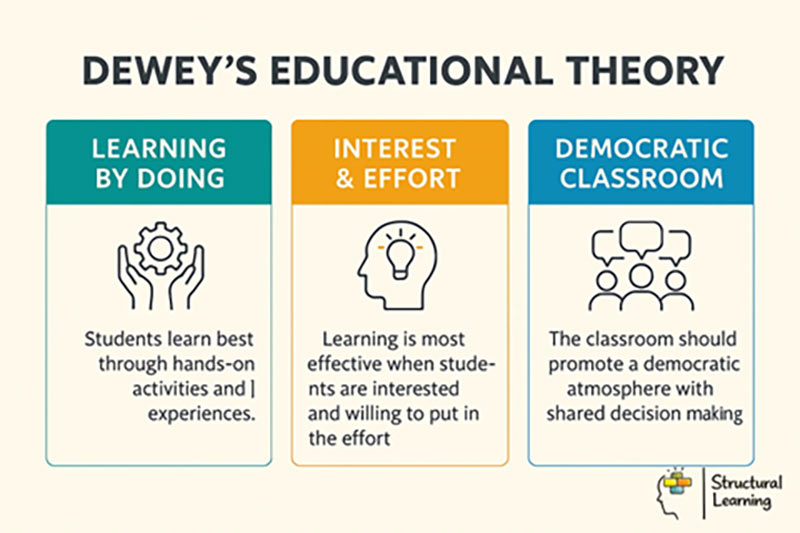
Educational theorists, John Dewey and Jean Piaget, explain that “learning follows a natural three-part cycle that begins with a sense of purpose or a goal for learning”.
Learning Processes & Spatial Design
Considering truths regarding the Natural Learning Process, design can adopt similar criteria.
Learning space design being defined as:
- Design is active.
- Design is interactive.
- Design supports appropriate challenges.
- Design is purposeful.
There are numerous theories connecting these cognitive and design concepts:
- Color Psychology
- Prospect-Refuge Theory
- Biophilic Design
- Sensory Experience
- Layout & Flow
- Functionalism… and more.
These design theories prove over and over how purposeful design “reduces stress and anxiety, boosts mood and energy, enhances productivity, and supports identity and belonging”.
Connection
So how can we connect notions such as Natural Learning Processes and Design Theory, with the hustle and bustle of an educator’s daily schedule?
It’s very simple.
Design learning spaces that intimately connect with core considerations:
- Demographic (experiences and background of those attending)
- Developmental needs of various age groups (physical, socio-emotional, cognitive etc.)
- Organizational culture (curriculum, methodology, management, communication, goals etc.)
How is this broken down in one space for one day?
Let’s take a look at the educator schedule again…
Learners and educators experience between 5-8 content blocks in a day. Which equates to 5-8 daily lesson plans. Each lesson plan is divided into components:
- Hook
- Main Idea
- Main Lesson
- Model/Peer Model
- Independent Work
- Share
Also commonly known as:
Hook – I Do – We Do – You Do
Daily lesson plans embed activities within each lesson component. Normally, educators have dozens of micro and macro-activities tucked inside their tool kit.
Enter the importance of design.
If I’m an educator… guided between 5-8 content blocks in a single day… following 5-8 daily plans… with detailed components… attempting to stay on track, on time, and meet my objectives/goals… I’m going to need a dang space that supports the learning community.
Here is a list of commonly used micro and macro activities, partnered with essential design convictions:
|
Activity |
Description |
Design Consideration |
|
Entry/Exit Ticket |
Essential questions asked pre/post lesson. Used for background data gathering and growth mapping. |
-Writing area -Differentiated seating/heights -Appropriate movement -Differentiated worksurfaces/heights -Organization of materials -Differentiation of textures/temperatures -Acoustic integrity -Lighting |
|
Brain Dump |
Encouraging learners to ‘brain dump’ what they know on a given topic. Used for background data gathering and discussion warmup. |
-Discussion space -Differentiated seating/heights -Appropriate movement -Differentiated worksurfaces/heights -Data collection space -Ease of access to information -Organization of materials -Acoustic integrity -Lighting |
|
Brain Teaser |
Introduction of a complex question or problem. Used to ignite curiosity, problem-solving, and discussion. |
-Independent space -Differentiated seating/heights -Appropriate movement -Differentiated worksurfaces/heights -Data collection space -Flow for independent to discussion transition -Acoustic integrity -Lighting |
|
Think, Pair, Share |
Commonly used mid-lesson. Encourages learners to digest concepts and discuss within pairs. Used for growth mapping, socio-emotional output, and skill development. |
-Discussion space -Engaging materials -Appropriate movement -Data collection space -Flow for discussion to whole group activity -Ease of access to individual supports -Acoustic integrity -Lighting |
|
Debate |
Commonly introduced post lesson and discussion/independent work. Used to showcase growth and encourage two-way complex communication. |
-Spatial flow -Common speaking space -Differentiated seating/heights -Appropriate movement -Differentiated worksurfaces/heights -Organization of materials -Data collection and display -Ease of access to individual supports |
|
Notice & Wonder |
Can be introduced throughout the lesson. Commonly used as a warmup to new lessons, units, or topics. Learners observe a quote, an image, short video, object etc. and co-create a list of their noticings and wonderings. Used to collect background data, co-create essential questions, highlight backwards design methods etc. |
-Discussion space -Differentiated seating/heights -Appropriate movement -Differentiated worksurfaces/heights -Data collection space -Ease of access to information -Organization of materials -Acoustic integrity -Lighting |
Supportive Layouts for Educational Spaces
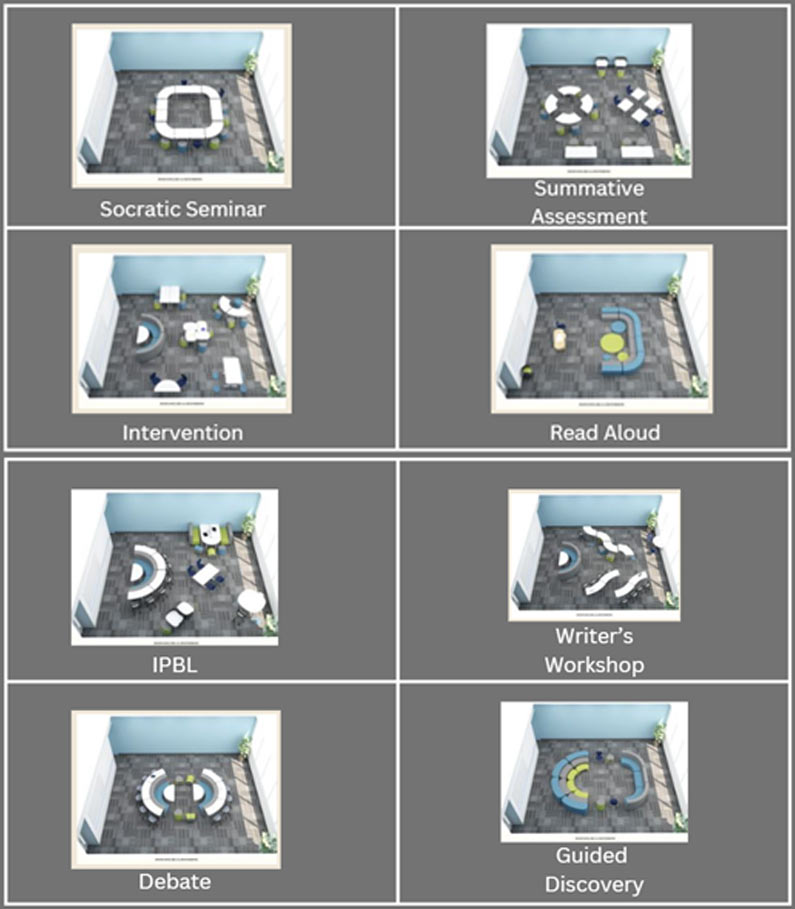
Well-equipped educational spaces mean environments that follow the truths of learning space design:
- Design is active.
- Design is interactive.
- Design supports appropriate challenges.
- Design is purposeful.
Well-designed learning spaces equate to phenomenal academic, socio-emotional, cognitive, and community outcomes. Designing intentionally is one of the best ways we can support learning communities.