
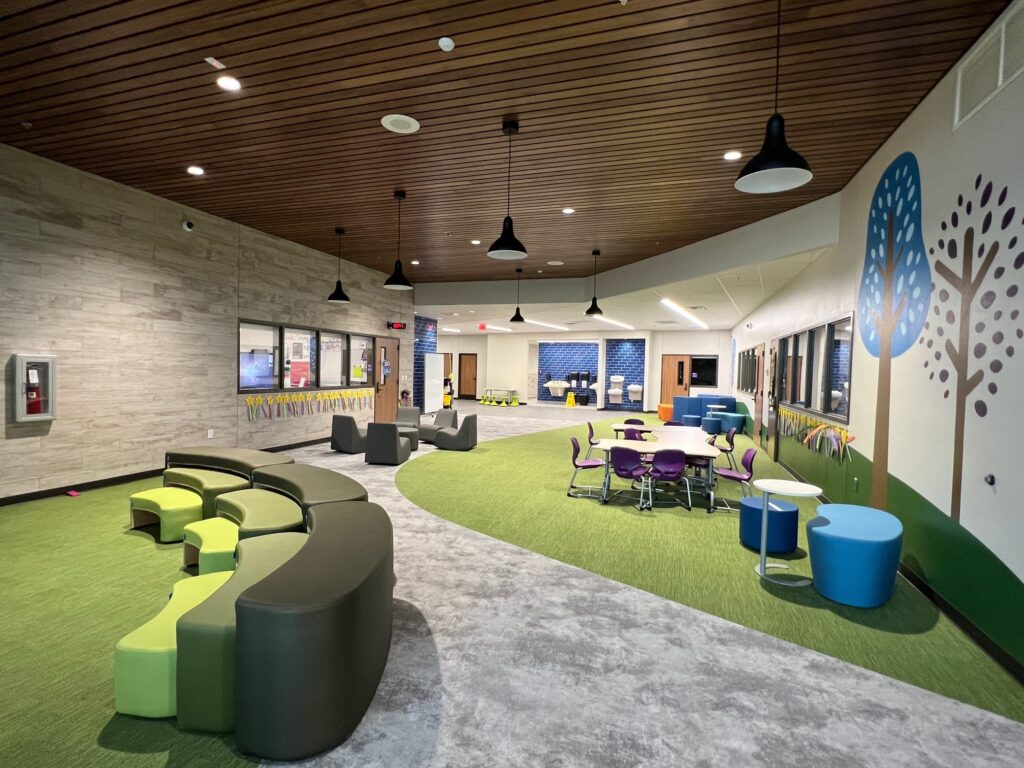
Why Curvature in Learning Spaces Is a Necessity, Not a Design Trend
NorvaNivel – Hannah Tejeda M.Ed
Walk into a standard school building and count the right angles. The hallway corners. The grid of ceiling tiles. The square doors set flush into flat walls. The rows of rectangular desks and tables pointing toward a rectangular whiteboard.
Now walk into a space with a curved alcove, a rounded reading nook, a gently arched threshold. Notice what happens in your nervous system. Something relaxes. Something arrives.
This is not coincidence, personal preference, or aesthetic sensitivity. It’s neuroscience. And it has massive implications for how schools are designed.
For decades, school architecture has defaulted to a grid — the efficient, the buildable, the cheapest per square foot. And even though we’re beginning to acknowledge efficiency has costs we’ve failed to measure, we don’t want to full admit that research is now blatantly clear:
Curvature in learning space design is not a luxury finish. It is a neurological need.
What the Brain Does with a Sharp Corner
The relationship between geometry and emotional processing has been studied deeply since around the 1920s. Researchers as early as Lundholm (1921) noted that humans consistently associated curved lines with softness, gentleness, and calm, while angular forms were described as robust, vigorous, and tense. For much of the twentieth century this was treated as aesthetic preference — interesting but not clinically meaningful.
Then neuroscience arrived at the question with fMRI machines, and now, the picture changes drastically.
The Bar and Neta Finding (2006, 2007)
Neuroscientist Moshe Bar and his colleague Maital Neta published a series of studies using brain imaging to examine responses to curved versus angular stimuli. Their central finding was hyper specific: sharp-angled objects and environments reliably activated the amygdala — the brain’s primary threat-detection and fear-processing center — while curved forms did not. This effect was not dependent on the objects being inherently dangerous. Abstract geometric angles with no contextual meaning still triggered the amygdala response. The sharpness itself was the signal.
This has a direct implication for schools. Every sharp corner in a hallway, every angular desk edge, every hard-edged threshold is sending a low-level threat signal to the individuals passing through. Multiply that across six hours, 180 days, twelve years of schooling, and the cognitive drain adds up.
The Vartanian et al. fMRI Study (PNAS, 2013)
The most rigorous architectural investigation came from Oshin Vartanian and colleagues in a 2013 study published in Proceedings of the National Academy of Sciences. Using functional magnetic resonance imaging, they showed participants images of interior rooms — some curvilinear, some rectilinear — and measured both behavioral and neural responses.
Participants were significantly more likely to judge curvilinear spaces as more beautiful than rectilinear ones. But more importantly, the evidence showed that viewing curvilinear spaces exclusively activated the anterior cingulate cortex (ACC) — a brain region strongly associated with reward processing, emotional salience, and positive approach motivation. The same fear-threat region Bar and Neta had found in object studies appeared here, now triggered by the geometry of a room.
“Curvilinear contour activated the anterior cingulate cortex exclusively, a region strongly responsive to the reward properties and emotional salience of objects. Pleasantness accounted for nearly 60% of the variance in beauty ratings.” — Vartanian et al., Proceedings of the National Academy of Sciences, 2013
The Plot Thickens…
Mobile EEG: What Happens When You Walk Through a Curved Space
A 2017 study published in Frontiers in Human Neuroscience took research out of a scanner and into lived experience, using mobile EEG to measure brain dynamics as participants walked through rooms with varying geometries.
Curvature had a strong impact on activity in the anterior cingulate cortex. The posterior cingulate cortex and occipital lobe were activated during spatial navigation in curved environments — structures involved in spatial memory, self-referential processing, and emotional context.
When people physically move through curved architecture, their brains process the experience differently — in ways that engage reward, emotional integration, and spatial self-orientation more richly than angular equivalents.
Translation Loading…
What Does This Mean?
Let’s translate the neuroscience into practical application for educators and designers.
A school built primarily on rectilinear geometry is not a neutral container for learning. It is an environment that sustains low-level amygdala activation, suppresses the reward circuitry associated with approach and engagement, and requires additional cognitive resources to down-regulate the threat signal. For neurotypical learners under low stress, this cost may be imperceptible most of the time. For individuals with anxiety, trauma histories, sensory sensitivities, or neurodivergent profiles — learners already managing significant regulatory demands — it is not imperceptible at all.
Introducing curvature into learning environments activates the brain’s reward receptors, reduces threat signals, and creates conditions in where approach motivation, emotional openness, and cognitive engagement are encouraged rather than suppressed.
|
What Angular Spaces Do to the Brain • Activates the amygdala (threat-detection, fear processing) • Sustains low-level vigilance, increasing metabolic cost of regulation • Reduces approach motivation — the instinct to enter and engage • Competes with executive function and working memory • May amplify existing anxiety or sensory sensitivity |
What Curved Spaces Do to the Brain • Activates the anterior cingulate cortex (reward, positive salience) • Reduces threat-detection load, freeing regulatory capacity • Increases approach motivation — the instinct to enter, stay, explore • Supports emotional integration and self-referential processing • Creates neurological conditions for belonging and engagement |
An added dimension exists that connects to monotropism. For individuals with ADHD or autism — who are already managing elevated demands — the environmental load of an angular space is not a small thing. Every tax on regulation is a deduction from capacity available for learning. Curved architecture reduces that tax before a single instructional decision has been made.
Implications: A Scales Introduction
At the furniture and classroom level
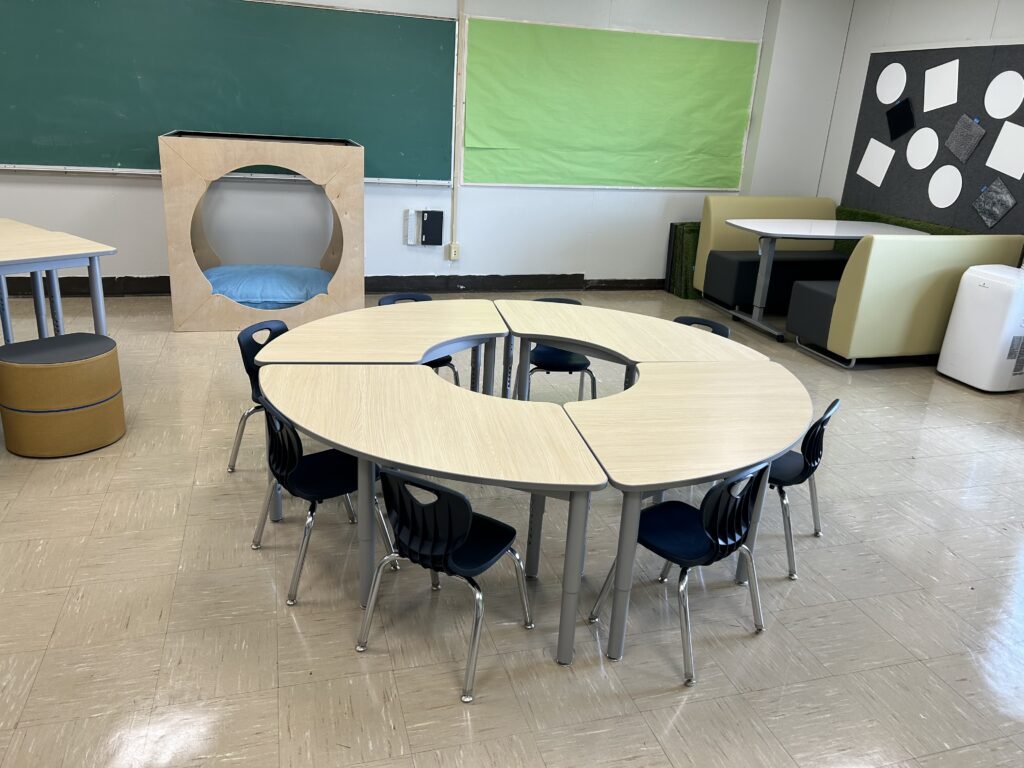
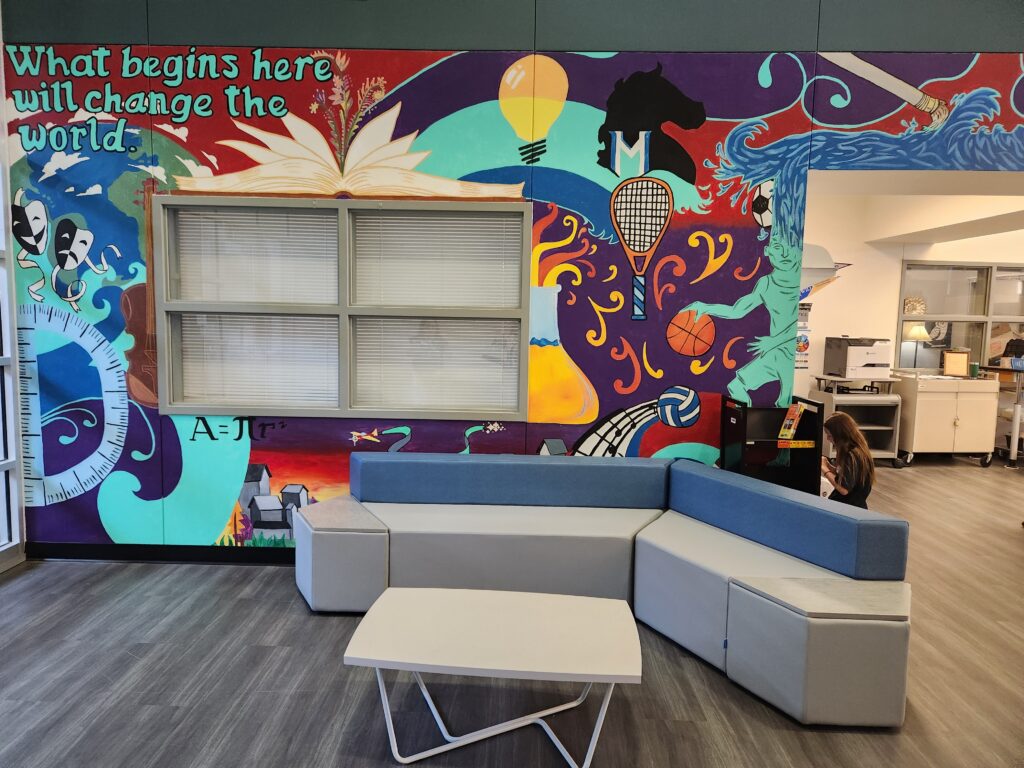
Round tables produce measurably different social dynamics than rectangular ones — there is no head of table, no implied hierarchy. Curved reading nooks and alcoves built from shelving or fabric create the partial enclosure that signals safety without isolation. Rounded corners on furniture reduce the ambient sharp-edge threat signal continuously. Replacing square-edged display frames with organic shapes and soft borders in bulletin board areas reduces visual tension without reducing information.
At the threshold and hallway level
Arched openings or curved threshold rugs at classroom entries reduce the abruptness of transition. Curved alcoves in hallways — even when built simply from angled shelving units — create natural decompression spaces. Softening the visual and tactile geometry at the most neurologically costly transition points (the moments between spaces) directly targets the environments where threat activation is highest.
At the architectural and renovation level
When renovation budgets allow, curved walls, organic ceiling profiles, and rounded corridor junctions have the strongest impact. The research on mobile EEG (Frontiers in Human Neuroscience, 2017) found that curvature effects on anterior cingulate cortex activation were strongest when participants were physically moving through space — meaning hallways and corridors, where learners are mobile, may be the highest-leverage targets for curved geometry investment.
What to Look for in Your Building
A Curvature Audit: Questions to Carry on Your Next Walkthrough
- At classroom thresholds: is the entry space angular and abrupt, or does any element — rug, shelf, soft surface — soften the geometry of arrival?
- In hallways: are the corridor walls unbroken planes of right angles, or are there alcoves, curves, organic materials that break the grid?
- In classrooms: does any furniture in the space have rounded rather than sharp edges? Are there reading nooks or curved enclosure elements?
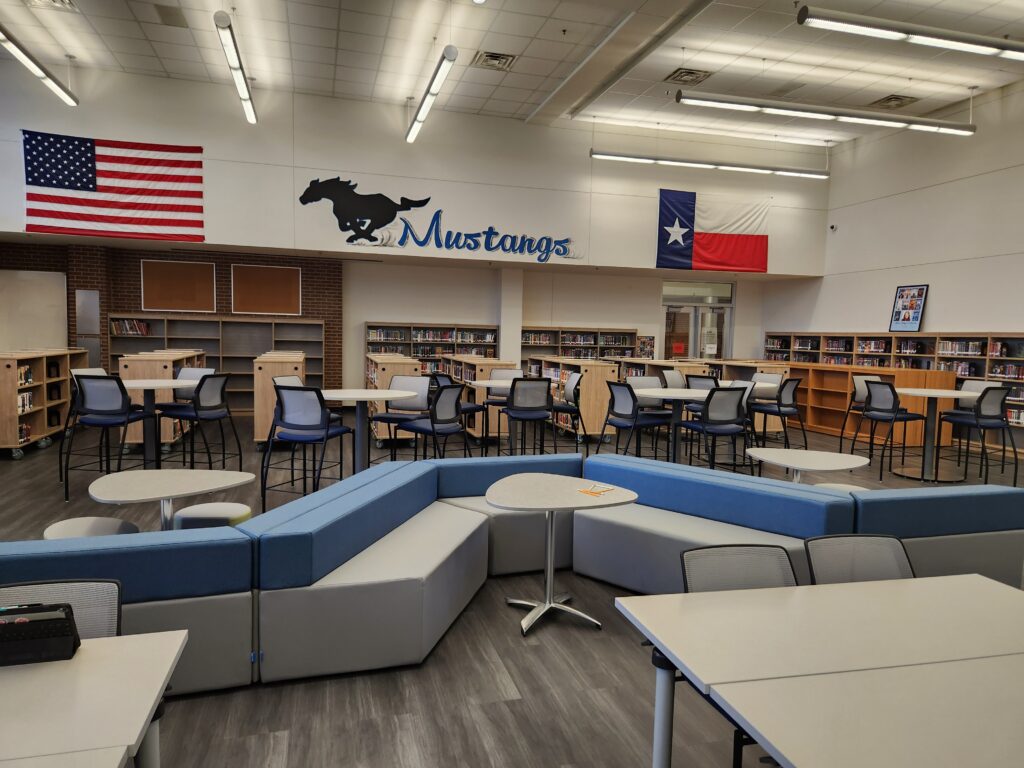
- In gathering spaces: are cafeteria and common areas dominated by rectangular grids of tables, or is there any organic variation in shape or layout?
- Overall: if you removed every sharp-angled element from the building, what would remain? How much of the geometry is serving efficiency, and how much is serving the nervous systems that spend all day in it?
None of this means every school needs to become the Guggenheim Bilbao. Incremental, cost-conscious curvature — a rounded table here, a curved threshold rug there, an arched shelf nook at the end of a hallway — is meaningful.
The nervous system does not require perfection. It requires relief from the constant low-level processing cost of the grid.
Research Sources
The following research informed this post and is recommended for deeper reading:
Vartanian, O., Navarrete, G., Chatterjee, A., et al. (2013). Impact of contour on aesthetic judgments and approach-avoidance decisions in architecture. Proceedings of the National Academy of Sciences, 110(Suppl 2), 10446–10453.
Bar, M. & Neta, M. (2006). Humans prefer curved visual objects. Psychological Science, 17(8), 645–648.
Bar, M. & Neta, M. (2007). Visual elements of subjective preference modulate amygdala activation. Neuropsychologia, 45(10), 2191–2200.
Schäfer, A., Nilsson, T., & Bläsi, C. (2017). Walking through architectural spaces: The impact of interior forms on human brain dynamics. Frontiers in Human Neuroscience, 11, 477.
Bertamini, M., Palumbo, L., Gheorghes, T. N., & Galatsidas, M. (2015). Do observers like curvature or do they dislike angularity? British Journal of Psychology, 107(3), 522–560.
Vartanian, O., Navarrete, G., Palumbo, L., & Chatterjee, A. (2021). Individual differences in preference for architectural interiors. Journal of Environmental Psychology, 77.
Barrett, P., Zhang, Y., Moffat, J., & Kobbacy, K. (2015). A holistic, multi-level analysis identifying the impact of classroom design on pupils’ learning. Building and Environment, 59, 678–689.
Gómez-Puerto, G., Munar, E., & Nadal, M. (2016). Preference for curvature: A historical and conceptual framework. Frontiers in Human Neuroscience, 9, 712.
Proshansky, H. M., Fabian, A. K., & Kaminoff, R. (1983). Place-identity: Physical world socialization of the self. Journal of Environmental Psychology, 3(1), 57–83.
Wilson, E.O. (1984). Biophilia. Harvard University Press.
Kaplan, S. (1995). The restorative benefits of nature: Toward an integrative framework. Journal of Environmental Psychology, 15(3), 169–182.
Hannah Tejeda · Educator · Independent Researcher · Keynote Speaker
Keynote: Step Into the Hallway · Workshop: Blueprint for Behavior: Designing Schools That Do the Work of MTSS
hannahtejeda.com