

By Hannah Tejeda
We spend enormous energy thinking about what learners see in their classrooms — the furniture arrangement, the bulletin boards, the color of the walls. We think carefully about what they touch, what they read, and what they’re asked to do.
But there is a dimension of the learning environment that most designers, school administrators, and even educators leave almost entirely to chance: what individuals hear.
Acoustics are not just an architectural consideration – it is an instructional support, an intervention tool, and essential design criteria.
Sound is what Julian Treasure has called “the invisible architecture” of a space. We can walk into a room and feel its acoustic character before we consciously register it. We know within seconds whether a room feels calm or chaotic, intimate or cavernous, safe or overwhelming. And yet when schools are built, renovated, or redesigned, acoustics are typically a siloed consideration.
That invisibility is costing learners… Quietly, measurably, and in ways that compound throughout the school year.
What We Mean When We Say Acoustics
Classroom acoustics refers to the relationship between sound and a physical space — specifically, how sound behaves once it enters a room. There are various types of Classroom Acoustics:
1. Background Noise
The ambient sound already present before an individual speaks: the hum of an HVAC system, traffic from outside, the shuffle of chairs, voices from the hallway, the collective murmur of learning. Every classroom has foundational background noise.
2. Reverberation Time
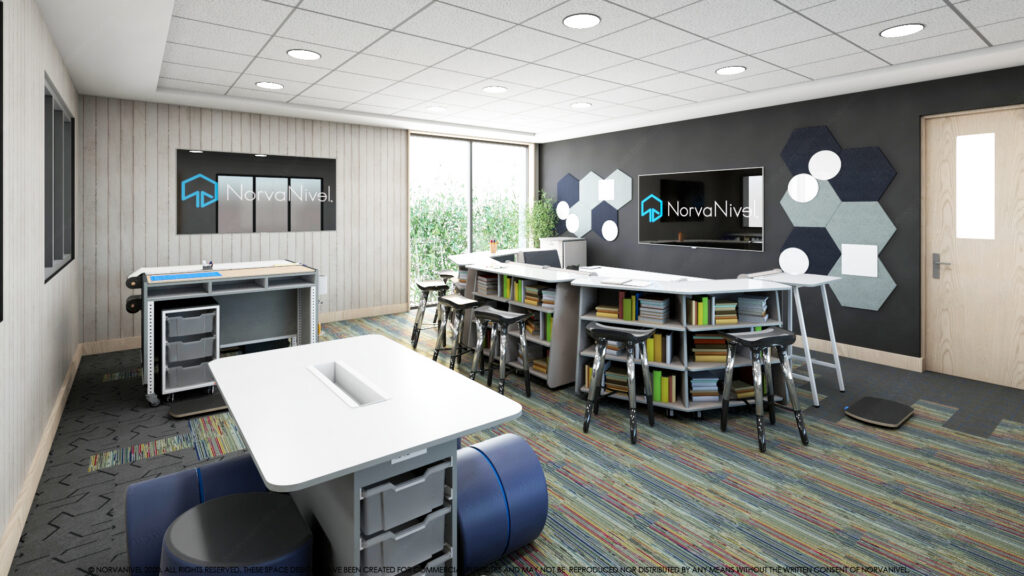
How long a sound continues bouncing around a room after its source has stopped. In a room full of hard surfaces — concrete floors, large windows, bare walls, drywall ceilings — sound continuously reflects. Research by the Acoustical Society of America shows that classrooms with little or no acoustic treatment have a reverberation time nearly three times greater than the recommended standard of 0.7 seconds.
Together, background noise and reverberation determine speech intelligibility — the degree to which a listener can accurately decode what a speaker is saying. And in a room full of children who are still developing language, still acquiring vocabulary, still building the phonological scaffolding that reading depends on, speech intelligibility is not a comfort issue… It’s an accessibility issue.
The Cost of Poor Acoustics on Learning
Baseline Cognitive Load
Research has consistently found that an inadequate acoustic environment impairs basic cognitive functions such as attention and memory — both of which are essential for learning and academic success. An individual who must work harder to decode speech has fewer cognitive resources available for overall processing and retention.
Acute noise, such as sudden interruptions, impairs speech perception, listening comprehension, and short-term memory, whereas chronic noise — particularly in classrooms with high reverberation — is associated with poor performance on verbal tasks and reduced reading ability. These effects are more pronounced in children than in adults, as younger learners’ executive functions are still developing and they have a limited ability to compensate for noisy environments.
This is the crux of the problem: the learners who are most harmed by poor acoustics are the youngest and most vulnerable, precisely because their brains are still building the tools that would help them manage auditory complexity. We are designing environments as though all children arrive with adult-level listening compensation skills. Most do not.
According to the Acoustical Society of America, in many classrooms in the United States up to 25% of the information can be missed because of excessive noise and reverberation.
The Educator’s Body Pays the Price
Poor classroom acoustics do not only affect learners. Educators are, in acoustic terms, the most exposed individuals in the building — speaking for hours each day in spaces that were not designed for sustained vocal use.
Research has found evidence for an association between noise exposure and vocal load and the development of vocal symptoms and cognitive fatigue after work among educators.
Studies demonstrate a significant relationship between increased classroom noise levels and worse voice-related quality of life among instructional staff, highlighting the need for improved acoustic management to reduce vocal strain.
The mechanism is well understood: when ambient noise rises, speakers unconsciously raise their vocal effort — pitch, volume, phonation time all increase. This is the Lombard effect, and it operates without conscious intention. An educator in a noisy space is not choosing to strain their voice. They are being driven to do so by the acoustic environment.
What Is Working?
The evidence base for acoustic intervention in schools is robust and growing — and the solutions, while sometimes requiring investment, are neither exotic nor prohibitively expensive:
- Acoustic panels and ceiling tiles
- Thoughtful material selection throughout the room
- Room geometry and layout
- Careful use of amplification
What Can Schools Do Right Now?
Acoustic improvement exists on a spectrum. Not every school can undertake a renovation. But every educator can begin making acoustic-aware decisions today.
Immediately accessible:
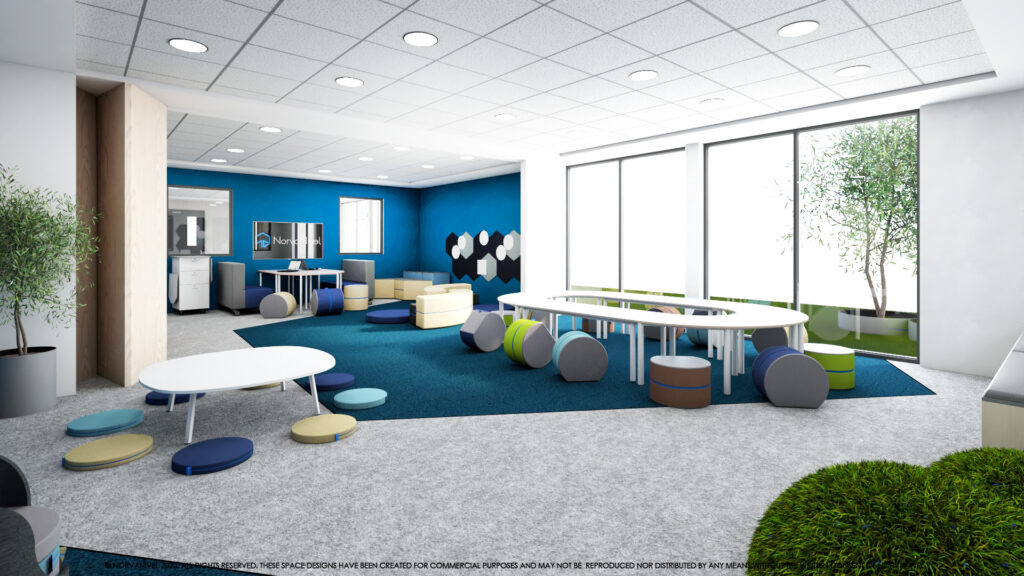
- Rugs – Soft floor covering is one of the most cost-effective acoustic interventions available.
- Bookshelves – Books are absorptive. A well-stocked, accessible bookshelf is simultaneously a literacy resource and an acoustic treatment.
- Fabric – Curtains, upholstered furniture, cushions, and fabric wall hangings all absorb sound.
- Logistics – Managing the transfer of hallway and adjacent-room noise is a daily design choice.
- Strategic Seating – Children who struggle with auditory processing, hearing differences, or language acquisition deserve front-and-center placement as a first response — not a last resort.
The Room Is Always Teaching
We have spent decades asking how educators can improve instruction. We have invested in curriculum, pedagogy, professional development, and assessment. All of it matters. But an individual delivering brilliant instruction in a room where a quarter of the content is acoustically lost is working against the design of the space they inhabit.
This is the argument for acoustic design in schools. It is not a luxury. It is not an add-on. It is the foundational act of believing that every individual in the room deserves to hear — and be heard — clearly.
References:
- Mercugliano, A., Corbani, A., Bigozzi, L., Vettori, G., & Incognito, O. (2025). The effects of classroom acoustic quality on student perception and wellbeing: a systematic review across educational levels. Frontiers in Psychology. DOI: 10.3389/fpsyg.2025.1586997
- Astolfi, A. et al. (2019). Influence of classroom acoustics on noise disturbance and well-being for first graders. Frontiers in Psychology.
- Kristiansen, J. et al. (2014). A study of classroom acoustics and school teachers’ noise exposure, voice load and speaking time during teaching, and the effects on vocal and mental fatigue development. PubMed.
- Mealings, K. (2023). A scoping review of the effect of classroom acoustic treatment on listening, learning, and well-being. Acoustics Australia.
- Minelli, G., Puglisi, G.E., & Astolfi, A. (2022). Acoustical parameters for learning in classroom: A review. Building and Environment.
- Visentin, C. et al. (2023). Individual characteristics moderate listening effort in noisy classrooms. Scientific Reports.
- Acoustical Society of America / ANSI. Classroom acoustics standards and guidelines.
- Acoustical Society of America. (2002). Classroom Acoustics I: A Resource for Creating Learning Environments with Desirable Listening Conditions.