
By Hannah Tejeda
There is a moment that every early childhood educator has witnessed. A child picks up a pinecone, a swatch of velvet, a piece of rough-cut wood, and before they can stop themselves, they are talking. Not prompted. Not coaxed. Just talking. Scratchy. Soft. Like a spider’s back. It feels like my grandpa’s jacket.
Something about touch unlocks language in a way that looking at a picture, or hearing a word, or reading a definition simply does not. It is not magic. It is neuroscience. And understanding it changes how we think about the materials, surfaces, and textures we choose to put, or not put, into learning spaces.
Let’s focus on that moment.
Let’s focus on why it happens, what research tells us about the relationship between texture and language, and what it means for how we design rooms where individuals grow.
Body Brain Connection
For a long time, educational theory treated language as primarily cognitive, something that happened above the neck mediated by instruction and exposure. We teach vocabulary by saying words. We reinforce them with visuals. We test them with worksheets. The body, if it was involved at all, was simply a delivery mechanism for getting the brain into a seat.
Embodied Cognition Theory fundamentally disrupted this model. The core claim of Embodied Cognition is that sensorimotor experience is not a passive section of processing – it’s active. What we have touched, moved, squeezed, stroked, and held shapes the architecture of our conceptual knowledge.
Word meanings are not stored as abstract symbols;
they are grounded in sensory and motor experience.
Research has shown that children younger than 8 have richer semantic representations for words with high “body-object interaction” words whose meanings they can physically handle and explore. When children comprehend words, they do not only activate a symbol: they activate a simulation of what it is like to interact with the thing the word names. The word “rough” is not just a label. It lives in the hands.
This matters profoundly for learning environments. If word meaning is grounded in sensory experience, then a room full of identical surfaces, identical materials, identical textures. A room that asks nothing of the hands is a room that is impoverishing the language development of the children who spend time in it.
Touch and Word Learning: What the Science Says
Infants manipulate objects and learn words – in that order
Research by Schroer and Yu (2022), using head-mounted eye-trackers, found that infants’ manipulation of objects with their hands, above and beyond simply looking at objects during naming, significantly explained variance in word learning. The act of touching, not just observing, was the decisive factor. Children who handled objects while those objects were being named retained the associated words more reliably than children who only looked.
This finding is consistent with a broader body of work showing that perceptual and motor experience impact word learning within a dynamic systems framework. Children are not passive receivers of vocabulary. They are active builders of it, and the hands are essential tools in that construction.
This aligns with current educational frameworks that include ‘modeling’ – where learners actively engage in physical embodying concepts to integrate understanding, create interdisciplinary comprehension, and assist with self-actualization.
Semantic Depth
Research has found that children exposed to greater semantic depth during word learning were better able to learn and articulate novel words. They showed more stability in their phonological representation of those words, a measure of how securely a new word has taken root in the lexical system.
When a word is connected to a sensory experience, it has more cognitive anchors. It does not float. It has weight, texture, and temperature.
Neurological Links
Neuroscientific evidence confirms what classroom teachers have long observed. Functional neuroimaging studies show that when participants perform perceptual discrimination tasks, the brain’s word-finding regions show co-activation. Language processing areas and sensory perception areas are not separate systems operating in parallel. They are in constant, reciprocal conversation.
The Environment as Second Teacher
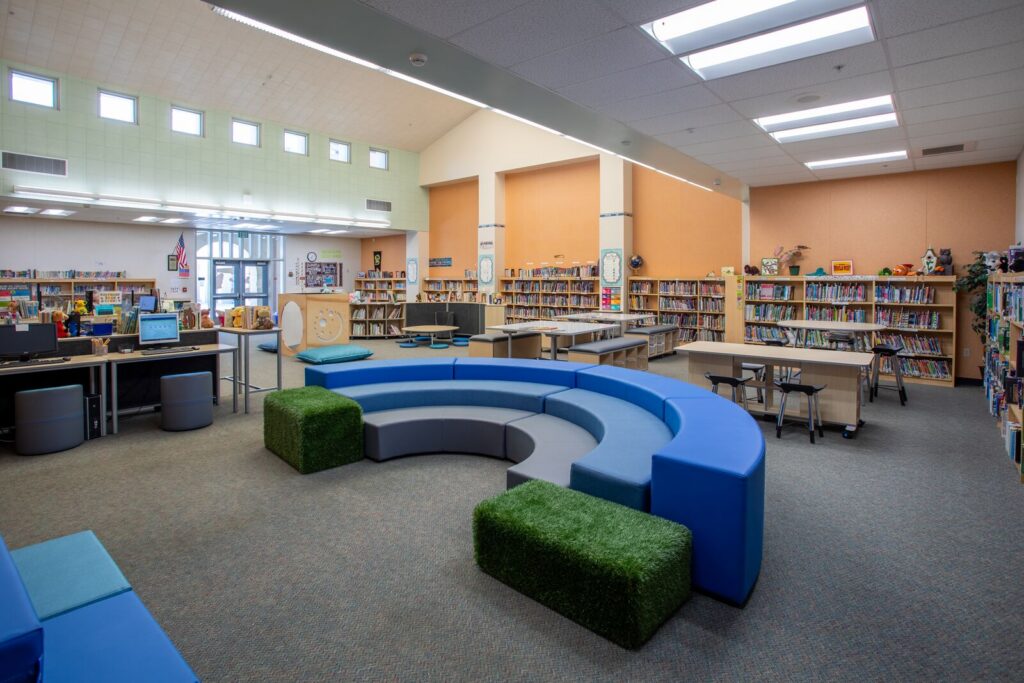
The Reggio Emilia philosophy holds that children have three teachers: adults, peers, and the physical environment itself. Loris Malaguzzi, who developed the Reggio approach in postwar northern Italy, insisted that the environment communicates to children that every corner of every space has an identity and a purpose, is rich in potential to engage and communicate, and is valued and cared for by children and adults alike.
In 2026, 22nd century learning spaces – adaptations to this philosophy have proven that the environment isn’t a third teacher… but, depending on the functional developmental group, a second teacher. Individuals learn and react to physical space before or parallel to communication with peers and other people.
For the youngest children, Reggio looks like responsive caregiving, calm rhythms, rich sensory play, and simple provocations light, sound, texture, loose parts. The environment supports secure attachment and exploration through low open shelving, soft materials, mirrors, and baskets to fill and empty.
The texture of materials is not incidental to this philosophy. It is the philosophy made physical. When a child reaches into a basket and finds rough bark next to smooth river stones next to curled dry leaves next to a piece of silk, they are being invited into a world that has things to say. And the language that emerges from that encounter is not retrieved from a vocabulary list. It is generated from experience.
Texture and MLL (Multi Language Learners)
ELL and Newcomers
For children who are acquiring a new language, the gap between what they know conceptually and what they can express linguistically can be enormous and emotionally exhausting.
They have full, complex inner worlds — understanding, observation, curiosity, humor — but lack the words in the target language to externalize them.
This gap is not a deficit. It is a design challenge. And texture helps bridge it.
When a child who is learning English touches something rough and hears the word “rough” — simultaneously feeling the sensation and hearing its name — they are creating a multisensory memory trace that is far more durable than a word presented on a flashcard. The word does not just enter the auditory channel. It enters through the hand. Research on Embodied Cognition confirms that learning a second language is most effective when grounded in physical, sensory action.
Speech and Language Differences
Individuals with language disorders, auditory processing difficulties, dyslexia, and autism spectrum conditions show sensory differences that influence their ability to acquire lexical items. Research in the area of Embodied Cognition and atypical language development has found that children with specific language impairment present motor deficits alongside their language challenges — suggesting that the motor and sensory systems involved in language acquisition are compromised alongside the linguistic systems themselves.
For these learners, a sensorially rich environment is not supplementary enrichment. It is a direct instructional accommodation. Providing multiple sensory pathways to word meaning — auditory, visual, and tactile simultaneously — increases the number of cognitive routes to any given word, and therefore the likelihood that the word will be retrieved, retained, and used.
The Language of Texture
When we design a learning environment with textural variety, we are doing something specific and powerful. We are expanding the vocabulary children have reason to acquire.
Think about what a child needs to discuss a rough surface versus a smooth one. They need adjectives. They need comparatives. They need the language of degree — rougher, softer, almost smooth, kind of scratchy. They need the language of similarity — it’s like sandpaper. They need the language of causality — it feels like that because it’s made of wood, I think, or maybe stone. They need the language of preference and feeling — I don’t like how it feels, but I keep touching it.
All of this language — descriptive, comparative, metaphorical, causal, affective — emerges naturally from a body in contact with a varied world.
None of it is generated by a smooth room.
Texture as a Design Principle
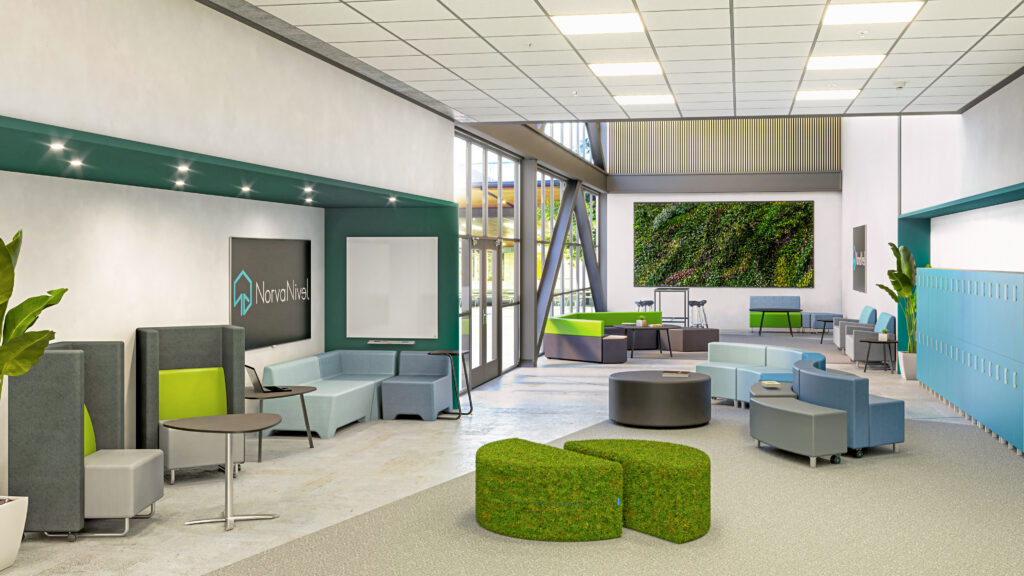
The argument for texture in learning environments is not an argument for sensory chaos or overstimulation. It is an argument for intentionality — for choosing materials with the same care that we choose books, selecting textures with the same deliberateness that we select fonts.
- Natural materials over synthetic ones wherever possible.
- Varied seating surfaces.
- Provocation baskets and loose parts.
- Textile and fabric elements.
- Sand, clay, and moldable materials.
Words Lived in Hands First
Maria Montessori said it plainly: What the hand does, the mind remembers. She said it in the context of letter tracing, but the principle extends far beyond phonics to every dimension of language development. The words that stay — the words that become truly owned, truly available for deployment in original sentences, truly integrated into a child’s expressive repertoire — are the words that lived in the body before they lived on the page.
This is not a romantic notion. It is a neurological one. Children exposed to greater semantic depth during word learning were better able to learn and articulate novel words when the word was linked with more sensorily rich semantic information. Richer sensory grounding equals more stable lexical acquisition.
This is measurable. It is replicable. It is happening or not happening in every classroom, every day, based in part on the materials that have been chosen to fill or empty that room.
References
- Schroer, S.E., & Yu, C. (2022). Infants’ manual manipulation of objects during naming significantly explains variance in word learning. Head-mounted eye-tracking study.
- Wellsby, M., & Pexman, P.M. (2014). Developing embodied cognition: insights from children’s concepts and language processing. Frontiers in Psychology. DOI: 10.3389/fpsyg.2014.00506
- Inkster, M. et al. (2016). Development of embodied word meanings: sensorimotor effects in children’s lexical processing. Frontiers in Psychology.
- Cadwell, L.B. Bringing Reggio Emilia Home. Teachers College Press.
- Malaguzzi, L. The Hundred Languages of Children. Reggio Children.
- Andrä, C., Mathias, B., Schwager, A., Macedonia, M., & von Kriegstein, K. (2020). Learning foreign language vocabulary with gestures and pictures enhances vocabulary memory for several months post-learning in eight-year-old school children.
- Journal of Innovation and Research in Primary Education (2025). Enhancing Language Development through Multisensory Media Interventions: A Classroom Action Research Study with Children Experiencing Speech Delays.
- Castro-Alonso, J.C. et al. (2024). Research Avenues Supporting Embodied Cognition in Learning and Instruction. Educational Psychology Review. DOI: 10.1007/s10648-024-09847-4